Norman, Oklahoma · Since 1961
A city boundary drawn
to protect our water.
More than six decades ago, Norman expanded eastward around the future Lake Thunderbird watershed. Today, that history asks a simple question: if eastern Norman is no longer meant to remain part of the city, who will protect the land, the water, and the people who call it home?
01 / The beginning
“To protect
the reservoir.”
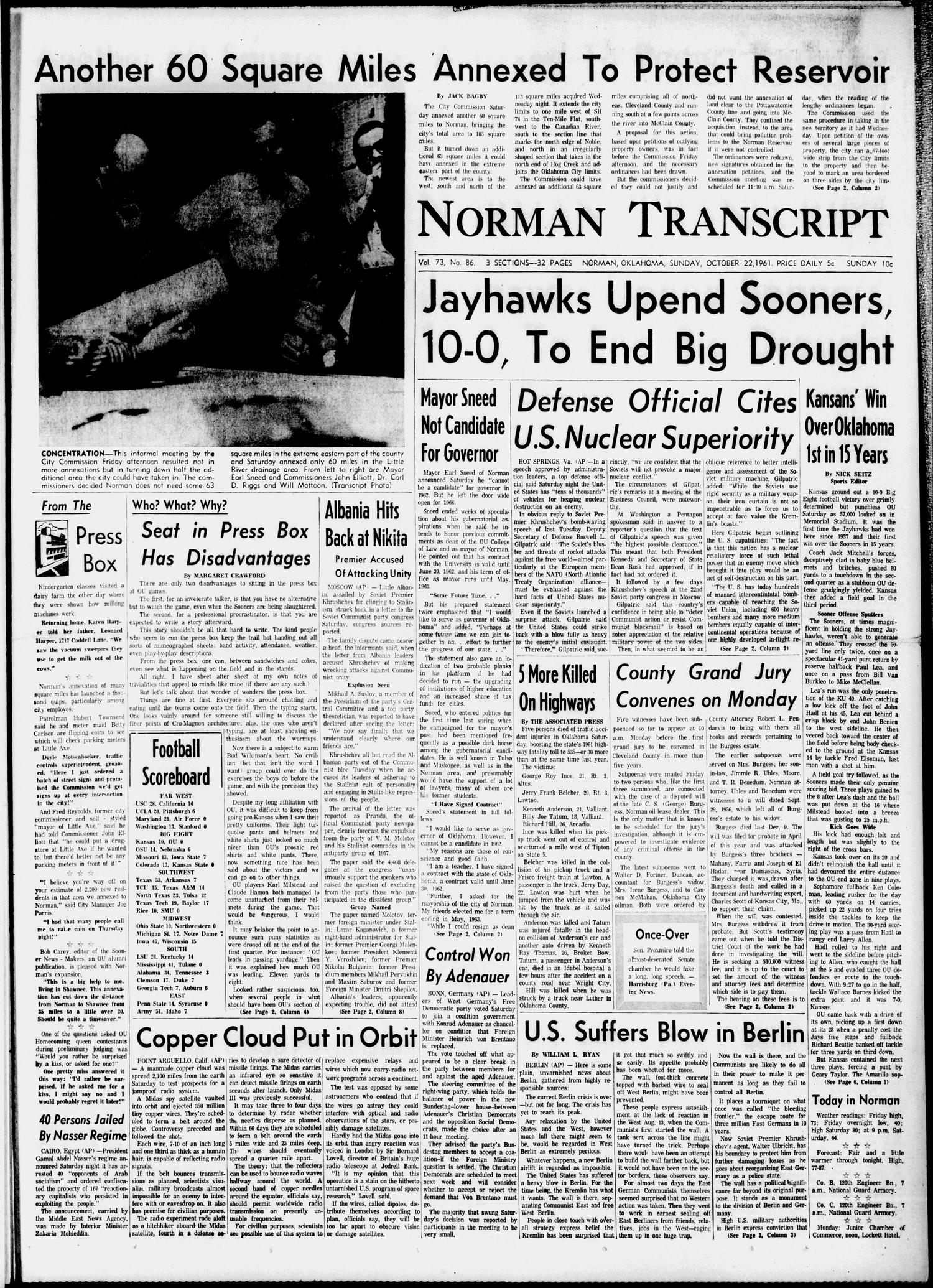
On October 22, 1961, the Norman Transcript put the reason in its headline. Norman’s City Commission had annexed another 60 square miles as part of a rapid series of boundary ordinances. The concern was not urban growth alone. Officials wanted authority over the watershed feeding Norman’s new reservoir so pollution could be controlled before it reached the city’s water supply.
02 / What happened
Ordinances 13-11
through 13-20
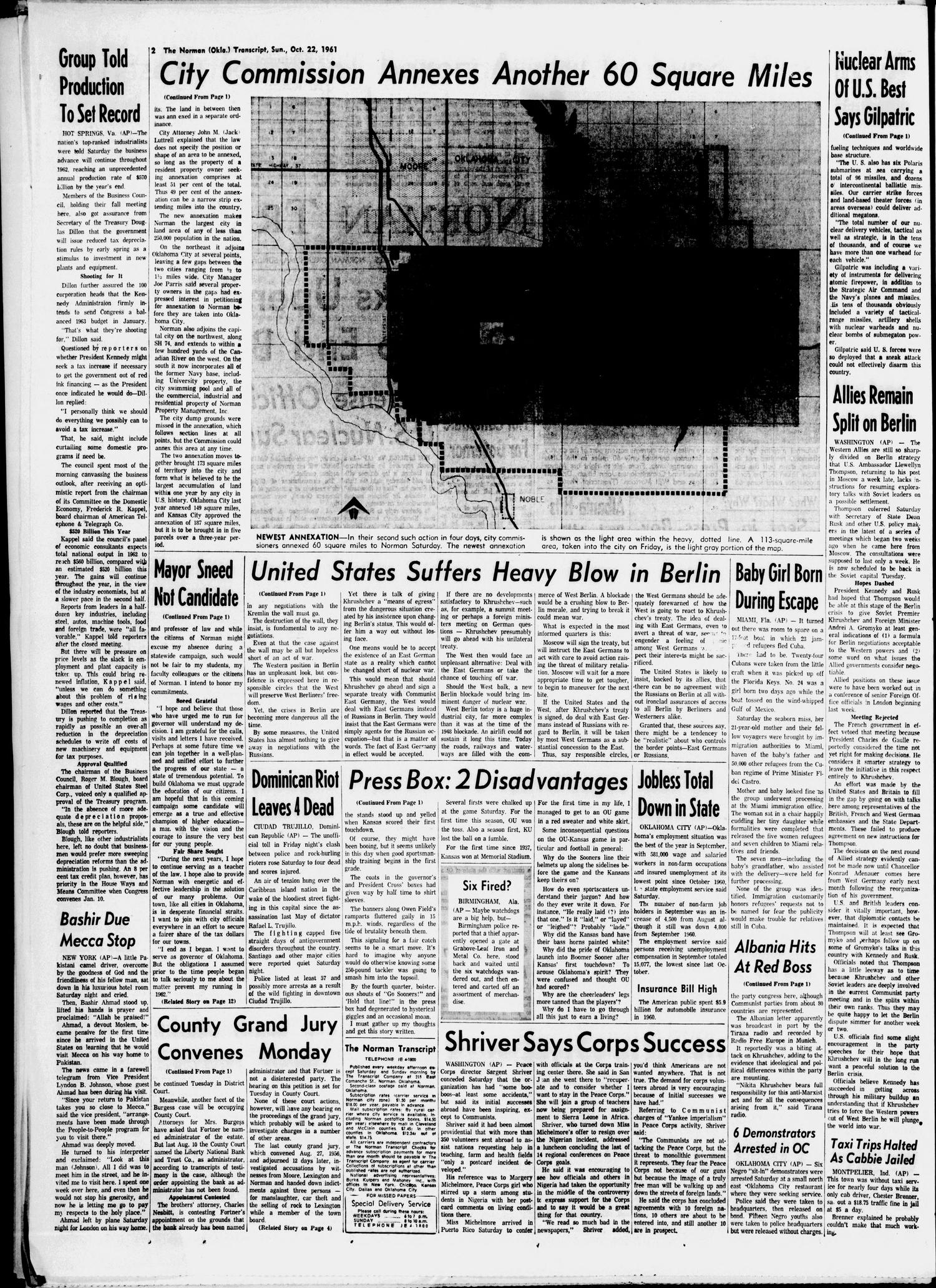
Through a sequence of annexation ordinances—13-11 through 13-20—Norman drew an immense new eastern boundary. The newspaper reported that 113 square miles had been added first, followed days later by another 60, bringing the city to approximately 183 square miles.
The territory stretched across rural land toward the reservoir and Canadian River drainage. The Commission used petitions from owners of large tracts to meet the annexation procedure then available under state law. The result joined places with very different densities, needs, and futures inside one municipal boundary.
“Another 60 Square Miles Annexed To Protect Reservoir”
— Norman Transcript, October 22, 1961
03 / Water promised later
Growth now.
Water later.
Norman adopted the AIM Norman Land Use Master Plan on July 14, 2026. Its growth framework anticipates additional housing and development while its infrastructure analysis identifies water and wastewater improvements needed to serve that growth.
The City’s underlying 2060 Strategic Water Supply Plan projected average-day demand rising from 17.1 million gallons per day in 2010 to 29.1 million by 2060. The adopted AIM plan recommends constructing either indirect potable reuse (IPR) or direct potable reuse (DPR) facilities to fill anticipated long-term supply gaps. IPR would return highly treated reclaimed water to Lake Thunderbird before drinking-water treatment; DPR would pipe advanced-treated reclaimed water directly to the water-treatment plant.
MGD in 2010
Average-day demand used as the plan’s baseline.
MGD projected for 2060
A 70% increase over the baseline.
Indirect potable reuse
Highly treated reclaimed water would first augment Lake Thunderbird.
Direct potable reuse
Advanced-treated reclaimed water would be piped directly to the water-treatment plant.
04 / The east put on the table
De-annexation,
proposed again.
In September 2026, Norman leaders again discussed potentially removing territory east of 60th Avenue from the city. News 9 reported that officials were weighing possible savings against effects on police, fire, roads, and trash service. No de-annexation had been adopted when the report aired.
The discussion treats the rural east—the territory added substantially to protect the watershed—as a cost question while Norman continues planning growth elsewhere.
Watch the 2:42 News 9 report ↗05 / Administrative accountability
The City reported 100%. The manager described a “bad rap.”
Darrel Pyle became Norman’s City Manager in July 2019. In June 2020, he told The Journal Record that Norman’s “bad rap” among builders had been a top priority since his arrival. The article described complaints that permitting was slow, inefficient, and costly, and quoted Pyle saying that “developers are the priority.”
Yet Norman’s FYE 2022 budget reported 100% for both FYE 2019 and FYE 2020 actual results on every published Planning Administration measure. The five Planning Services measures shown in later adopted budgets likewise remained 100% year after year. That apparent perfection did not contradict the reported permitting problems because the scorecard did not measure them: it counted timely meeting packets, forwarding items, processing applications, notices, and reports. It did not report permit-customer satisfaction, staff errors, resident responsiveness, or the overall experience Pyle said needed an overhaul.
The gap became clearer after the City adopted more specific Development Services measures. Its FYE 2025 budget reported that only 35% of residential applications in FYE 2022 and 51% in FYE 2023 were reviewed and approved within two days. Non-residential reviews within 14 days also fell from 96% to 86%. These are not proof that every staff function failed; they are proof that the earlier blanket 100% figures were not a meaningful measure of the permitting problem.
A manager publicly identified a serious service problem while the City’s official performance report continued to display perfect results on measures too narrow to reveal it. Council and residents were not given a scorecard capable of testing whether management’s promised improvement was working.
“Bad rap” and permitting overhaul, June 2020 ↗FYE 2022 performance report ↗FYE 2025 Development Services results ↗
One final effort to work with the City
Water first.
Let Norman choose.
We have drafted a formal citizen demand asking Council to address management accountability, reconsider AIM Norman, pause major new water-intensive approvals, and adopt a permanent “water first” policy. A strong response gives the City one last opportunity to correct course—and could make a petition for a new municipality unnecessary.